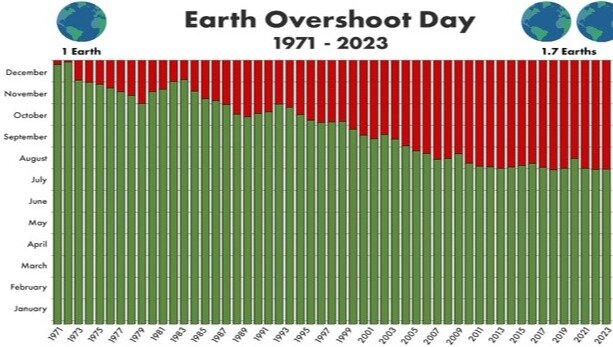
World Ecological Debt Day is the event that highlights the impact of human activities on the environment. It is determined by calculating the average number of days in which terrestrial biodiversity manages to provide for the human ecological footprint: it is, in fact, the day on which humanity has consumed all the natural resources that the Earth can regenerate in a year.
This year, World Ecological Debt Day arrived on August 2, which means we have exhausted the natural resources that the planet can provide in a single year and are living at the expense of the future. This is a warning sign indicating the need to take urgent measures to protect and preserve the environment.
In 1973, Overshoot Day fell on December 3: we exceeded our annual budget by just a few days. In 2003, it was September 12, and in 2023, August 2.
Globally we are consuming the equivalent of 1.7 planets per year, a figure that, if we maintain the same terrible growth trend, should rise to two planets by 2030.
This means that humanity has been in ecological overshoot for over 50 years and the debt we have accumulated amounts to 19 years of the planet's production, that is, what Earth's ecosystems could regenerate in 19 years if we were in the same ecological conditions as in 1973.
The United Nations, with the IPCC goal of reducing greenhouse gas emissions by 43% by 2030 (compared to 2010), have set programs that, however, are not always respected by the signatory countries, further postponing the first necessary milestone for our survival as human beings.
Reversing course is necessary; we should urgently address the problem of soil aridification caused by climate change, human exploitation, and the prolonged use over the years of chemical fertilizers and pesticides.
If we halved food waste worldwide, for example, we could gain 13 more days on the calendar. While reforesting 350 million hectares of land would move the date by 8 days. The most decisive contribution would come from abandoning fossil fuels, the main culprits of the climate crisis. According to experts' estimates, reducing CO2 emissions from energy production by 50% would allow us to postpone Overshoot Day by more than three months (93 days).
In Italy, this year, the date of ecological debt was May 15, placing us among the countries that consume the most natural resources.
To date, if everyone lived like Italians, 2.8 planet Earths would be needed to meet collective needs. It would take 5 if everyone lived like a US citizen.